In a nutshell
- A slow float along a crack in the earth, with rock walls on both sides and clear water underneath you.
- Glacial meltwater filtered through porous underground lava for 30-100 years before it reaches the fissure.[1]
- Þingvellir is where the North American and Eurasian plates break apart and the land between subsides.[2]
- Water temperatures stay at 2°C to 4°C all year round, and the fissure never freezes.[1]
- Snorkelers must be at least 12 years old, at least 150 cm tall and comfortable in water.[3]
- Top choice Silfra Fissure Snorkeling from US$137 Duration3 - 5.5 hours[4]Group sizeLimited to 6 participants[4]PickupAvailable, check availability[4]Rating4.71 from 2,142 reviews[4] Check availability
- Silfra Snorkeling + Photos from US$215 Duration4.5 hours[5]Group sizeLimited to 6 participants[5]PickupIncluded, check availability[5]Rating4.83 from 628 reviews[5] See this tour
- Silfra Diving Day Tour from US$283 Duration3 - 5 hours[6]Group sizeLimited to 3 participants[6]PickupAvailable, check availability[6]Rating4.60 from 74 reviews[6] See this tour
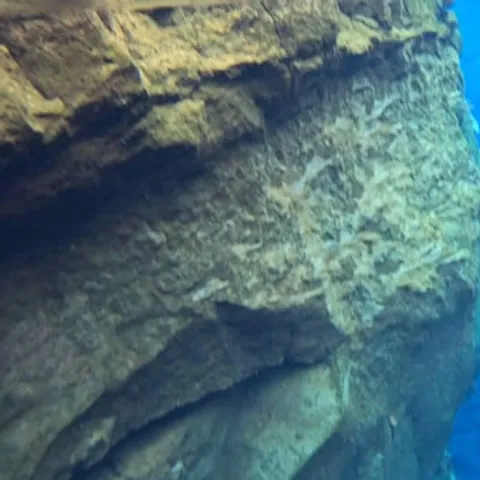
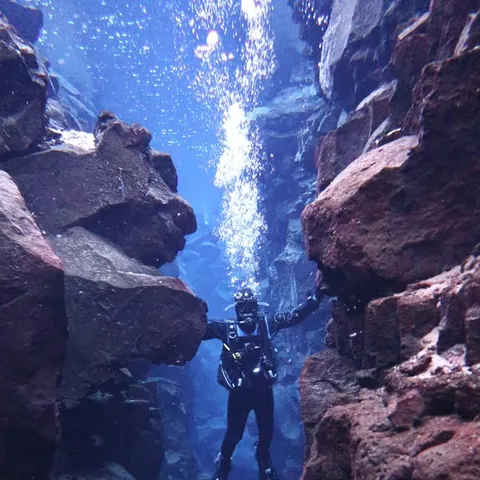
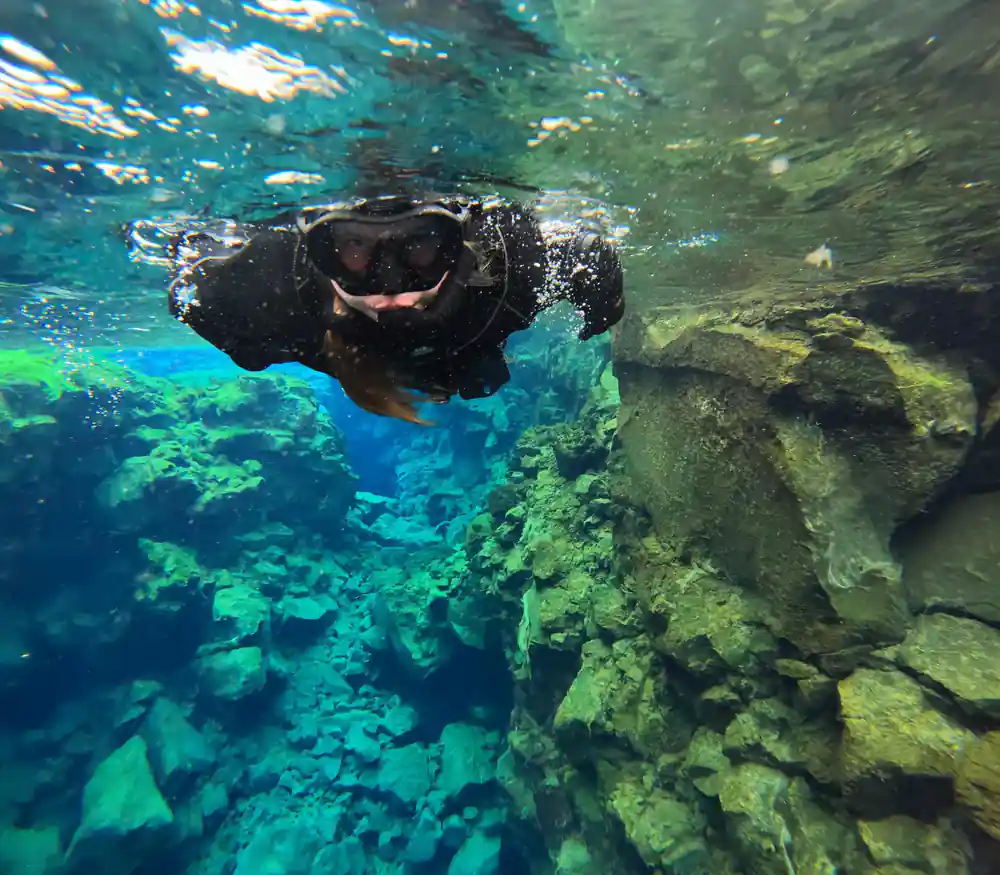
The marine life in Silfra consists mostly of bright green “troll hair” and different types of algae that provide a colorscape unlike anything that occurs naturally above the surface.
Is the Silfra snorkeling tour worth it?
Before reserving
The walk to the water at Þingvellir
Silfra sits inside Þingvellir National Park, 47 km northeast of Reykjavík on Route 36.[7] The park was added to UNESCO's World Heritage List in 2004, and it receives approximately 1.5 million visitors each year.[8][9] Away from the car park the noise drops quickly. You walk a short way over broken lava, and the ground opens into a corridor of grey rock with water lying along the bottom of it.
The first thing you notice is how still the surface looks. There is no surf and no tide, just a long, narrow channel of water held between two walls of rock. Guides hand out gear, check seals and hoods, and talk the group through what happens next. The entry itself is careful and unhurried rather than dramatic: cold air on your face, a mask that fogs for a second, then the moment you put your head under and the world above disappears.
The walk down is short, which is a mercy once you are sealed in. You shuffle rather than stride, the collar presses on your neck and the hood sits loose until it is tucked and tightened. Guides keep everyone close, because the path narrows and the last stretch drops toward the water. What arrives before the water does is anticipation: you can see the colour of the channel from a distance, and it looks impossibly bright for somewhere this cold.
The first breath: cold, then quiet
The glacial meltwater in Silfra stays very cold and remains 2°C to 4°C all year round, and it never freezes because fresh water is constantly filling the fissure.[1] That sounds worse than it feels when you are floating face down and moving rather than standing still. The cold arrives on the strips of skin that stay exposed: cheeks, lips, the small triangle around the mask. Your breathing is loud in your own ears for the first minute or so, and then it settles into a slow, even rhythm that matches the pace of the group.
There is also a quiet that takes people by surprise. With your head under the surface, the world above disappears and you hear only your own inhale and exhale, plus the odd clink of gear from the person beside you. The water you are floating in has been filtered through porous underground lava for 30-100 years before reaching the spring that feeds into Silfra.[1] Nothing about that journey shows on the surface. What you notice instead is how little there is to disturb you: no swell to time and no boat wake to watch for.

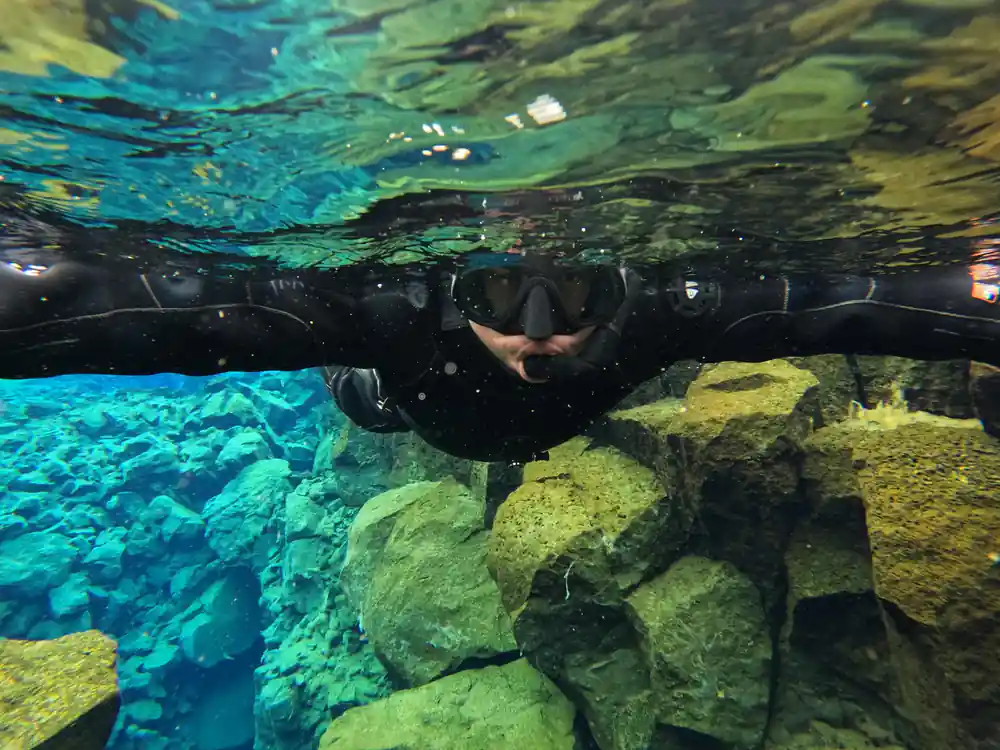
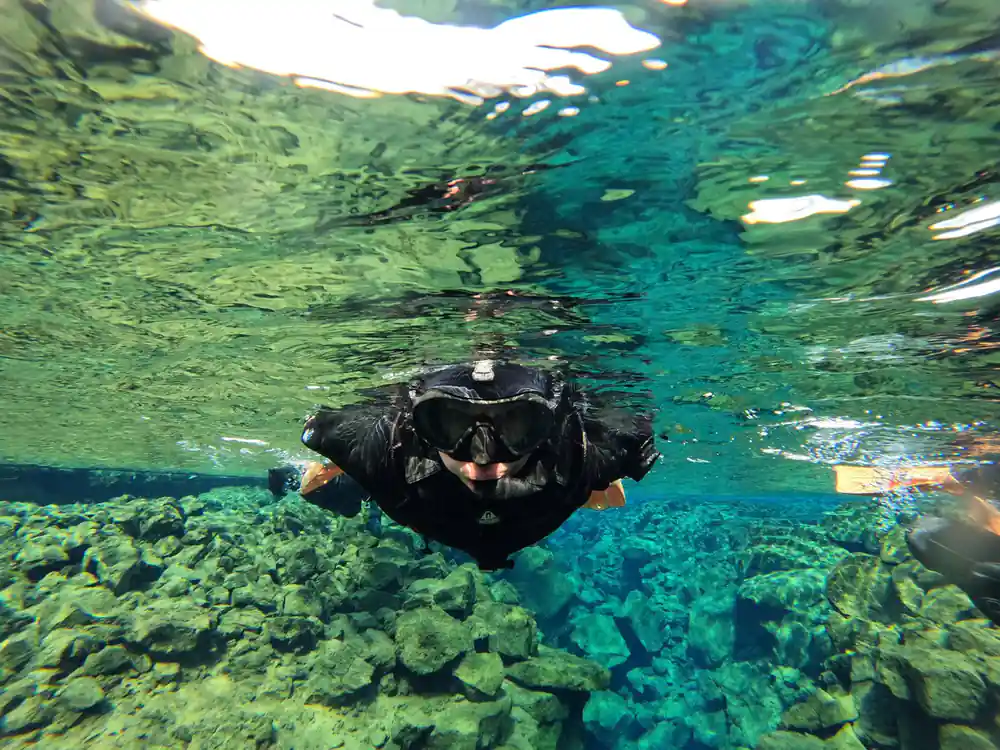
A snorkeler floats over bright sand between the walls of the Silfra fissure.
Swimming between two continents
Þingvellir is where the North American and Eurasian plates break apart and the land between them subsides. In the rift zones, tensional stress accumulates during a long period and is then released in a burst of activity, while away from the plate boundaries the movement is fairly constant at about two centimetres a year.[2] Snorkeling between continents in Iceland means a straight line of rock on either side of you: one wall on one plate, the other wall on the other. Few swims come with a label that big.
Nothing dramatic happens as you cross. There is no line in the water, no marker to swim past, no ceremony. The fissure simply narrows and widens around you, and the far end of the channel fills with a blue that keeps changing as you move. Crossing a continental divide turns out to be a slow, quiet process measured in fin kicks, and that is what makes it stick: for a few minutes you are a small warm body in a very old gap in the earth.
Guides usually keep the group in single file, and that shape adds to the feeling. You follow the bright hood ahead of you, the rock slides past on both sides, and the person in front becomes your measure of speed. Look sideways instead of forward and you catch the seam between the plates at eye level, a band of light and shadow that runs the length of the swim without ever looking like a line on a map.
How sound and sight change underwater
Visibility in Silfra is over 100 meters, so there is no murky middle distance to swim through and no moment when the far wall fades out.[1] Depth perception goes first. A rock that looks an arm's length away can be well below your fins, and the pale floor of the shallows reads as much closer than it is. Snorkelers tend to slow down here without being asked, because the eye keeps finding detail: cracks, pebbles, the shadow of your buddy on the sand.
Sound is the other surprise. Above water, a group of snorkelers is a noisy, clanking thing. Below, most of that vanishes and you are left with the hiss of your own breathing, the occasional clink of gear and the muffled rumble of someone adjusting a mask nearby. Talking to your guide happens in gestures: a wave, a pointed finger, a thumbs up. It is one of the few activities where not being able to chat makes the experience feel larger rather than smaller.
from US$137
The Reykjavík: Silfra Fissure Snorkeling between Two Continents tour starts from US$137 and takes a small group of 6 participants.[4]
The blues, the greens and the light
Colour shifts the whole way along. In the shallow end the water is nearly transparent and the rock reads as grey and bone white. Further along, where the channel deepens and the walls close in, everything takes on a saturated blue that seems to come from below rather than from the sky. The marine life here is not the draw, but it does add colour: mostly bright green troll hair and different types of algae, clinging to rock where the light reaches.[1]
Weather changes the palette without changing the water. On a bright day the surface throws moving shapes onto the walls; on a grey day the blues go deeper and flatter. What stays the same is the temperature and the clarity. Nearby lies Þingvallavatn, the lake that covers 84 square kilometres and has a greatest depth of 114 metres.[10] Standing at the exit afterwards, with your hood off, that wide flat sheet of water is what you look at while your hands start working again.
The light does something particular in the narrow middle section. Bright sand below you bounces light upward, the walls catch it, and the result is a glow that seems to come from the rock itself. Photographs rarely hold it, and the memory tends to collapse into a single colour by the time you are back in the car.
Depth, space and the cathedral walls
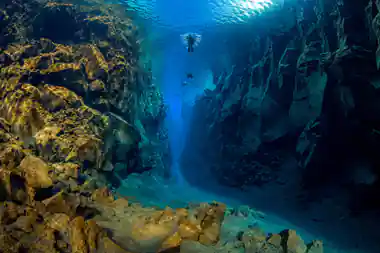
Silfra reaches depths of up to 200 feet (60 meters) in its deepest sections, though most snorkeling takes place near the surface.[11] That combination is what makes the swim feel bigger than it looks on a map. You float along the top while the floor falls away beneath you, and the walls rise on both sides until the sky is a narrow strip of light. It is the closest thing to flying that most of us will ever do.
The narrowest sections are the ones people talk about afterwards. Here the two walls come close enough to touch with both arms out, and your buddy's fins are suddenly at eye level as the channel bends. Snorkeling stays near the surface, while diving Silfra requires either a drysuit diver certification or drysuit dive experience.[11][12] You look down into the blue from above, and the guide sets a line that keeps everyone in the bright water.
Then the sense of scale goes strange. Rock that looked small from the entry towers over you, and the pale sand floor sits far below your fins. Your breathing sounds exactly as it did at the start. The walls hold the quiet in, the light bends through the water, and you realise you have stopped kicking and are simply drifting forward.
Surfacing, and what stays with you
The end arrives before you expect it. There is one last stretch of open water, a set of steps, and then the strange, heavy feeling of a body back under gravity. Hoods come off, masks steam up, and everyone talks at once about the same handful of moments: the first cold, the point where the walls closed in, the blue at the far end. The swim is short in memory and long in detail.
Practicalities matter if you are booking. Snorkelers must be at least 12 years old, at least 150 cm tall, and able to swim and be comfortable in water, and life jackets and swimming aids are not permitted at Silfra.[3] The Reykjavík: Silfra Fissure Snorkeling between Two Continents tour runs 3 - 5.5 hours, is limited to a small group of 6 participants and starts from US$137.[4] Whatever the weather is doing above the surface, the water below is the same cold, clear place it has been for a very long time.
From-prices for Silfra tours
Each bar is a from-price taken from the listings cited:[4][5][13][14]
What a Silfra snorkeling day costs
Amounts are adult from-prices in US dollars from the listings cited:[4][5][13][14]
When to book your Silfra snorkeling
What to expect
Meet and get kitted out
Guides fit masks, hoods and snorkels, check the seals, and explain the hand signals you will use once you are in the water.
Walk down to the entry
A short walk over lava rock brings the group to the steps, where you sit, seal up and slide in when the guide says go.
The first minute
Cold water reaches your face, your breathing sounds loud, and then both settle into a slow rhythm as the group starts moving.
The swim through the fissure
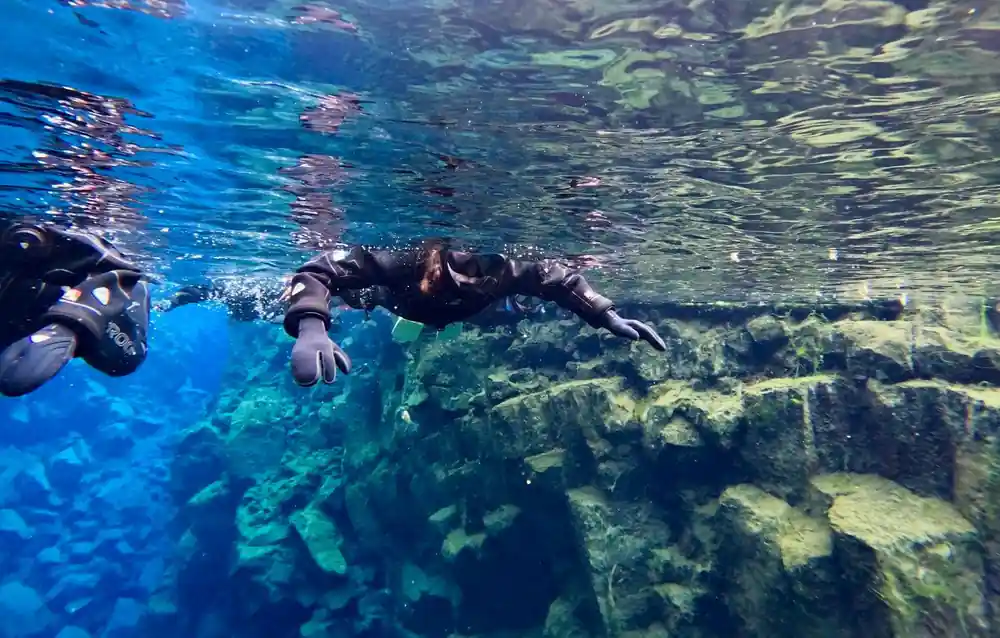
You follow the guide along the channel, floating over pale sand and looking down into blue, with rock walls drifting past either side.
Exit and warm up
You climb out at the far end, peel off the hood, and walk back with the group, usually talking about the same two or three moments.
Ready to float between two continents in Iceland?
from US$138Reserve now & pay later