In a nutshell
- A dry suit keeps water off your skin; warmth comes from the layers you wear under it, not from the shell itself.
- The meltwater in the fissure stays at 2°C to 4°C all year round and never freezes. Expect the same cold every season.[1]
- Snorkelers must be at least 12 years old and at least 150 cm tall, able to swim and comfortable in water; life jackets and swimming aids are not permitted.[2]
- Hood, gloves and neck seal work as one system. Check each seal before you step down into the water, and speak up if anything pinches.
- The tour booked from this site runs 3 - 5.5 hours, keeps groups to 6 participants and starts from US$137, with free cancellation up to 24 hours in advance.[3]
- Top choice Silfra Fissure Snorkeling from US$137 Duration3 - 5.5 hours[3]Rating4.71 from 2,142 reviews[3]PickupPickup available[3]CancellationFull refund up to 24 hours ahead[3] Check availability
- Snorkeling with Photos from US$215 Duration4.5 hours[4]Rating4.83 from 628 reviews[4]PickupPickup included[4]CancellationFull refund up to 24 hours ahead[4] See this tour
- Golden Circle and Silfra from US$298 Duration10 hours[5]Rating4.82 from 304 reviews[5]PickupPickup included[5]CancellationFull refund up to 24 hours ahead[5] See this tour
To dive Silfra you are required to have either a drysuit diver certification or drysuit dive experience.
Is dry suiting at Silfra worth it?
Before reserving
What a dry suit actually does
A dry suit is a shell, not a sponge. A wetsuit works by trapping a thin layer of water against your skin and warming it. A dry suit refuses to let water reach your skin at all. Neoprene or laminated fabric, a waterproof zip across the shoulders, and rubber gaskets at the neck and wrists do the sealing. Warmth comes from what you wear underneath.
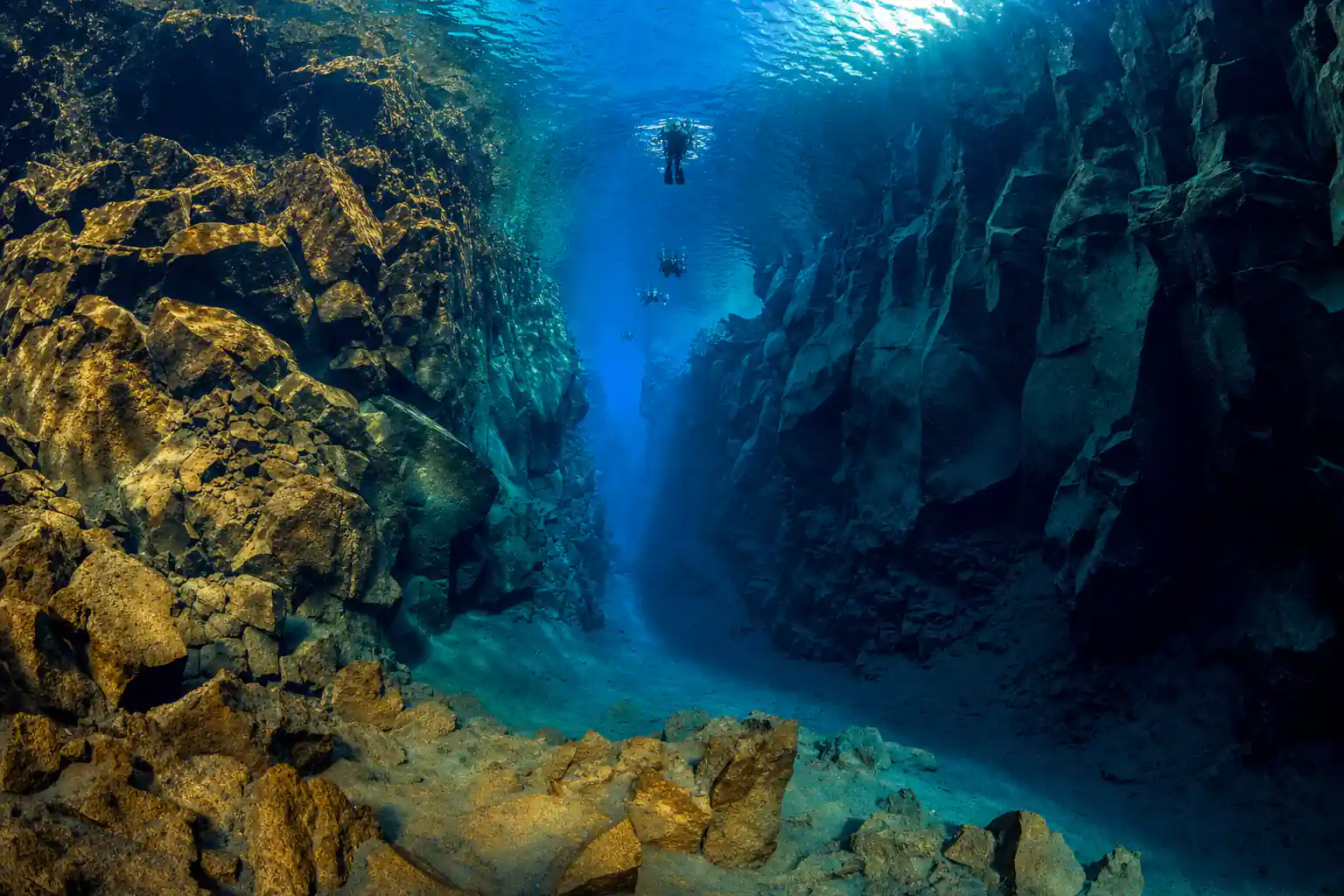
At Silfra the difference is not academic. The glacial meltwater in the fissure stays at 2°C to 4°C all year round and never freezes.[1] It reaches the spring after filtering through porous underground lava for 30-100 years.[1] The water is extremely pure by the time it arrives, and visibility runs to over 100 meters.[1] A wetsuit relies on a warmed layer of water against the skin, and meltwater of that temperature offers nothing. A dry suit takes the problem away.
The suit is bulky on land and that is normal. Shoulders feel stiff, the neck gasket tugs, and you walk like a slightly inflated person. Once you are horizontal in the water, most of the awkwardness goes. The suit's job is to hold a layer of air and a layer of insulation around you, and floating makes that easy.
The thermal undersuit and the air layer
Insulation under a dry suit is not optional. Almost none of your warmth comes from the shell itself; it comes from the layer next to your skin. A fleece one-piece or a thermal base layer is the usual choice: warm, thin and smooth enough not to bunch under the gaskets. Cotton is the fabric to leave behind, because it holds moisture and then sits cold against you.
The other half of the system is air. A dry suit is not skin tight. Once the zip is closed, a thin layer of air is trapped around your body, and that air moves. Stand upright and it rises to your shoulders. Lie face down and it gathers along your back and under your arms. In the water you float inside a sealed bubble instead of swimming in a wet second skin.
Guides vent the suit before entry, squeezing the excess out at the neck so you do not balloon at the surface. A little air is fine. Too much and you bob with your face pushed up out of the water, which makes breathing through the snorkel awkward. If you feel over-inflated mid-swim, stop, straighten up slightly and let the air escape.
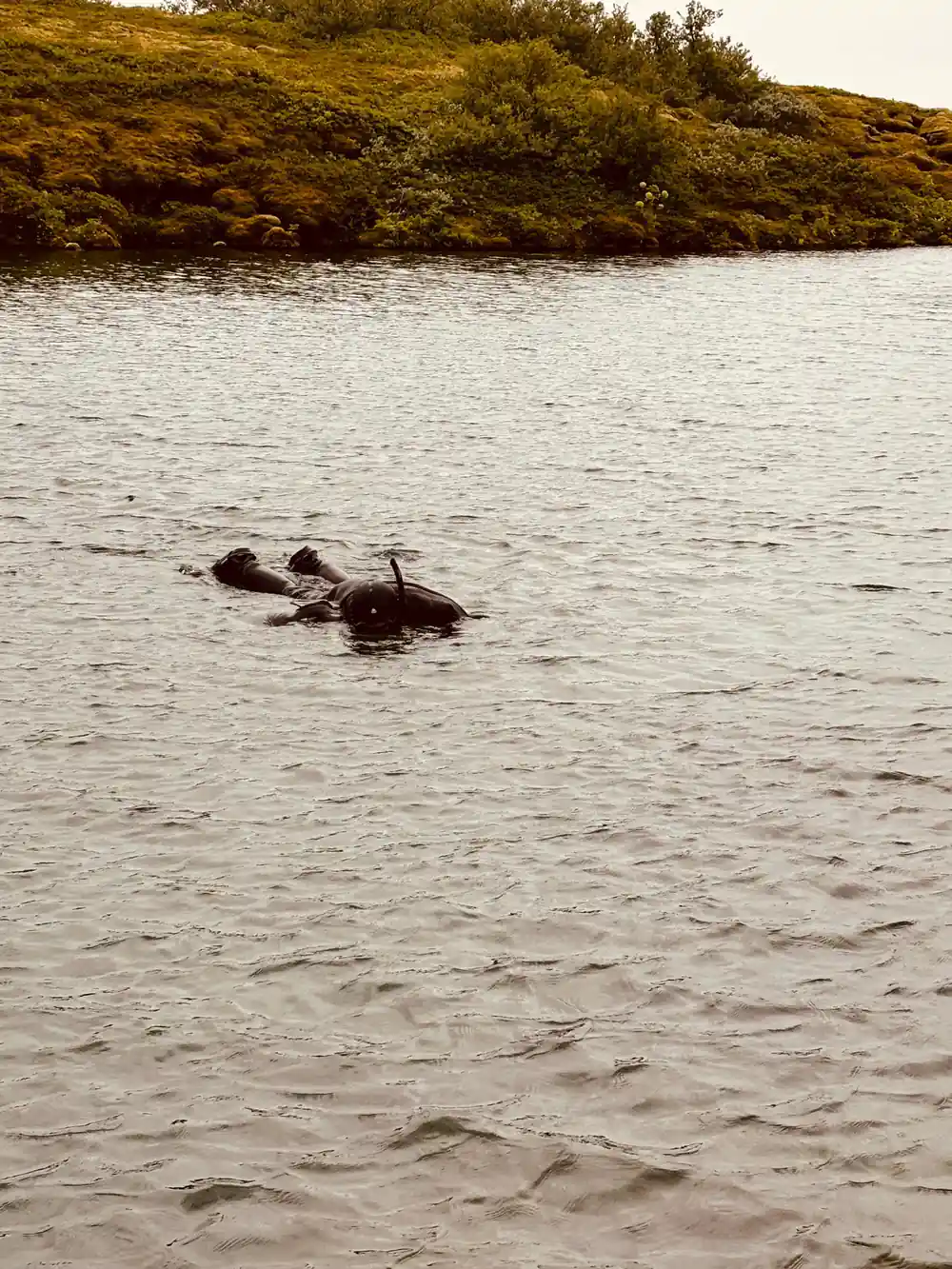
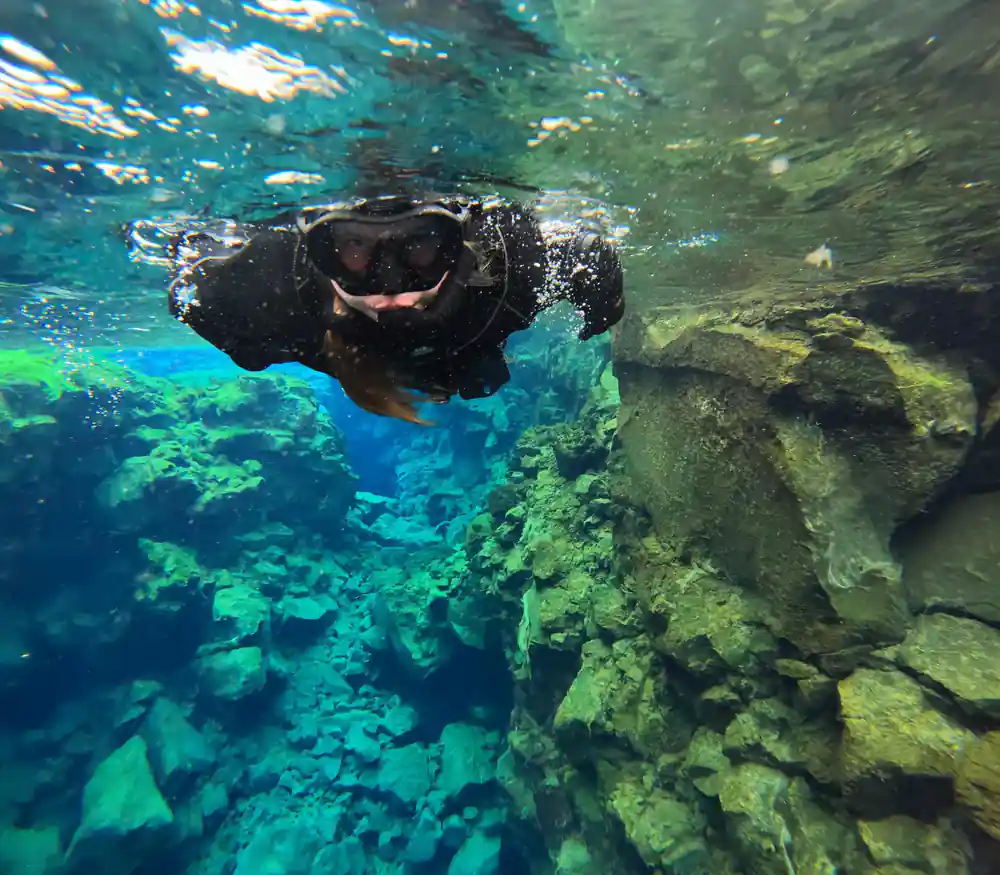
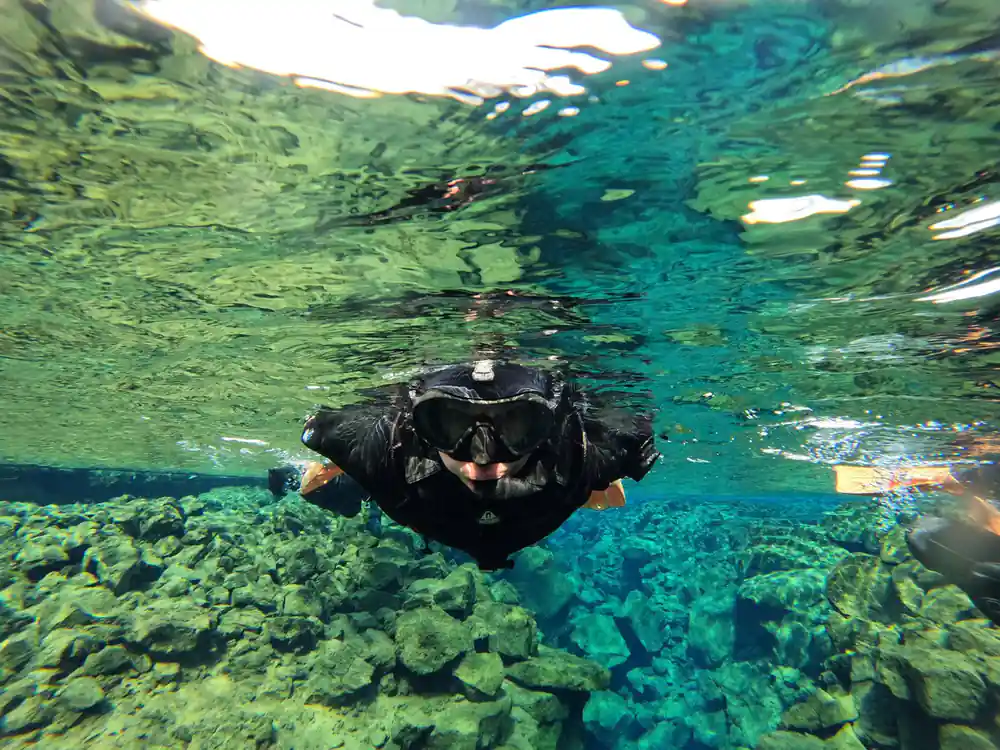
A snorkeler surfaces in the fissure, dry suit still sealed, with the canyon walls behind.
Why you float face-down in a dry suit
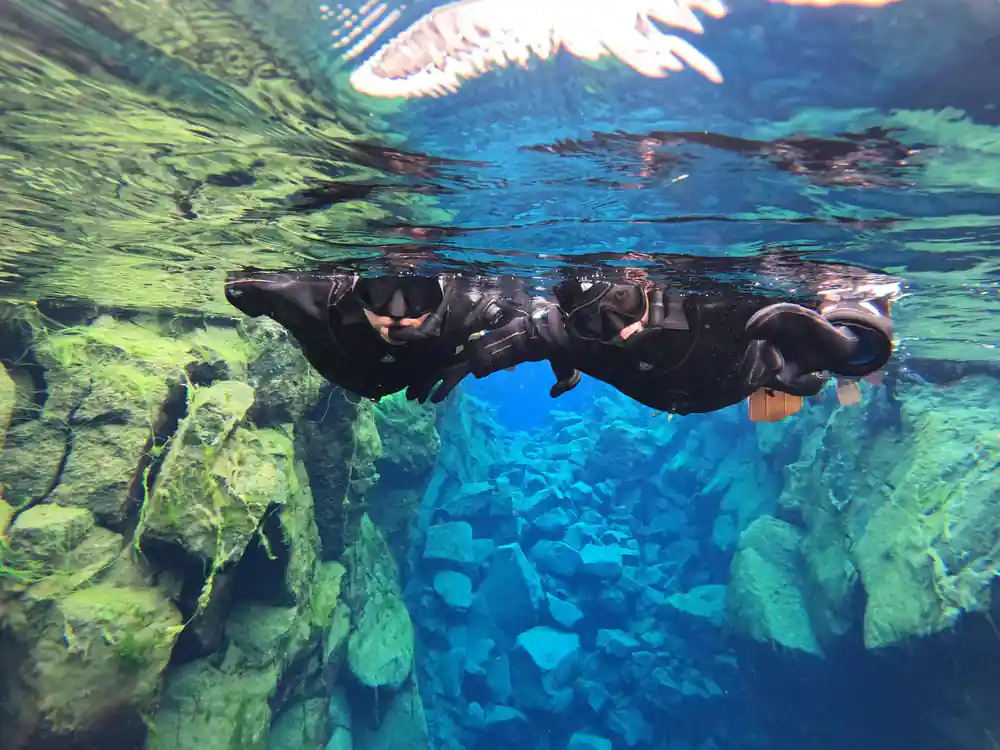
Snorkelers at Silfra travel face down, drifting through a crack in the lava. In a dry suit that posture comes almost free. The trapped air sits along your back, the fabric adds buoyancy of its own, and your body settles into a flat float without effort. You do not need to tread water or hold yourself up. Your arms rest at your sides or stretch lightly forward, and your head stays down with the mask just under the surface.
The trick is to stop fighting it. New snorkelers often lift their heads to look around, which pushes the feet down and lets water into the snorkel. Keep your face in the water, breathe slowly, and let the suit carry you. To look sideways, turn your whole body rather than craning your neck.
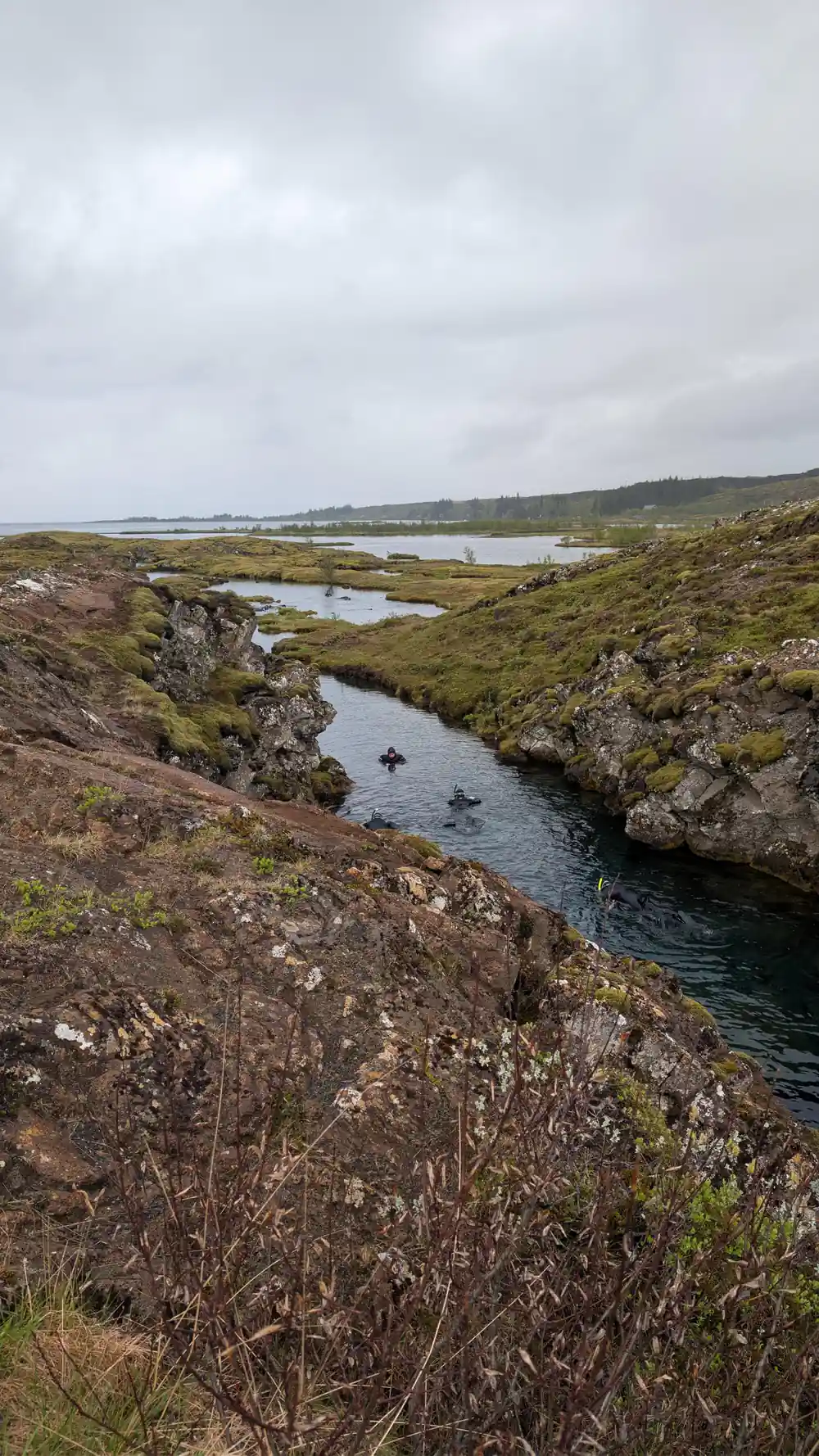
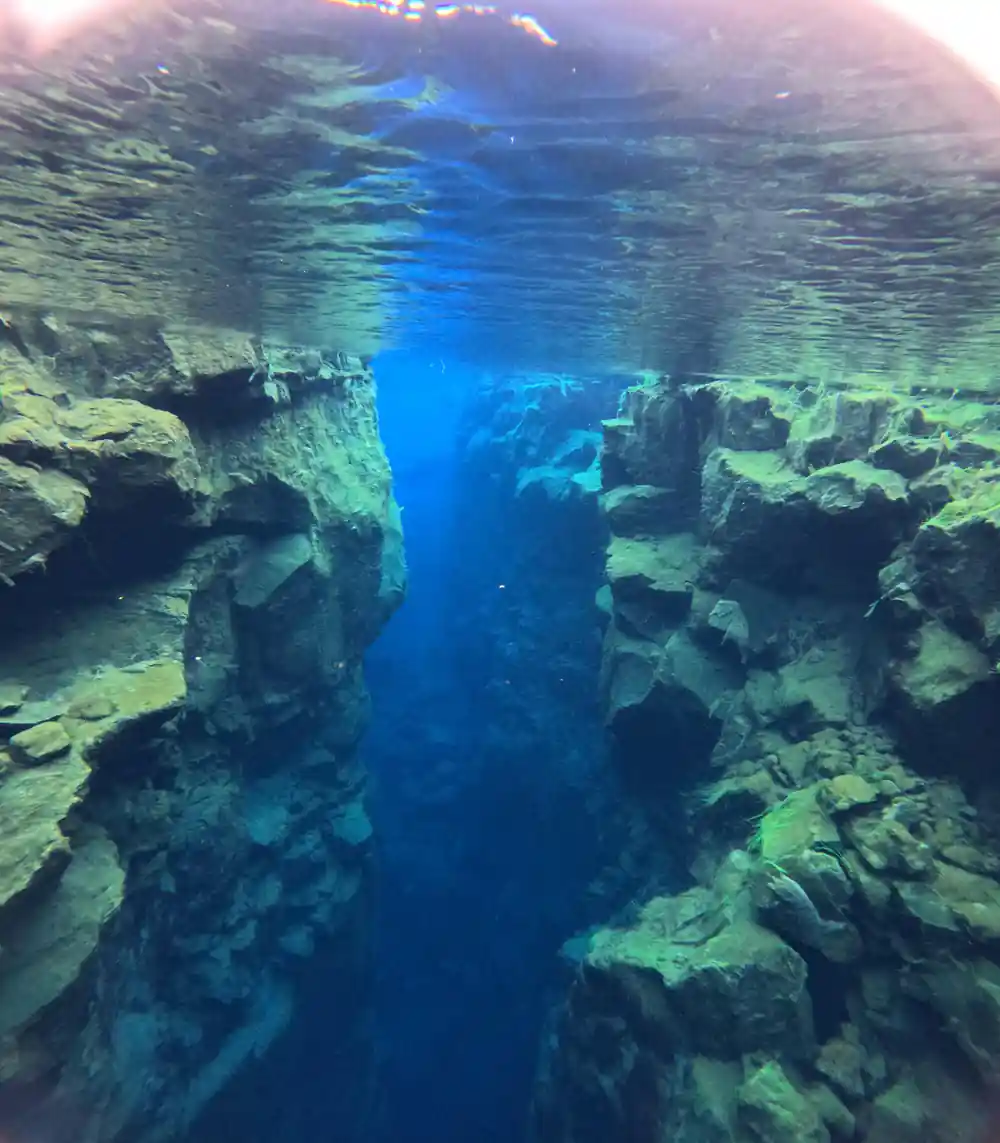
Depth is worth knowing about even though you stay near the surface. Silfra reaches depths of up to 200 feet (60 meters) in its deepest sections, and most snorkeling takes place near the surface.[6] Below you the crack narrows into blue, and the rock around you carries bright green troll hair and other algae.[1] At Þingvellir the North American and Eurasian plates break apart and the land between them subsides. Away from the plate boundaries the movement is fairly constant at about two centimetres a year, while in the rift zones tensional stress accumulates and is released in bursts.[7]
Mobility and kicking in the suit
Dry suits restrict movement. The fabric does not stretch, the shoulders resist big arm strokes, and the gaskets remind you they are there whenever you turn your head. Fins matter more than usual here. They give you propulsion from the ankle, so your hips and shoulders stay relaxed and the suit stays flat in the water. Long fins give more push but need more ankle strength; shorter ones are easier to manage in a stiff suit.
Use a slow flutter kick and keep it narrow. Wide scissor kicks stir up silt, and the appeal of Silfra is clear water, with visibility of over 100 meters.[1] You are drifting through a fissure, not racing. Many snorkelers hold their legs almost still and let the dry suit's buoyancy do the work.
If the suit feels tight across the chest or pinches under the arms, say so before you get in. Swapping sizes beside the van is far easier than swapping in the water. Squat, reach overhead and roll your shoulders once you are zipped up. That tells you straight away whether the fit is right.
from US$137
The Silfra snorkel runs 3 - 5.5 hours, keeps groups to 6 participants and offers free cancellation up to 24 hours in advance.[3]
Hood, gloves and boots as part of the system
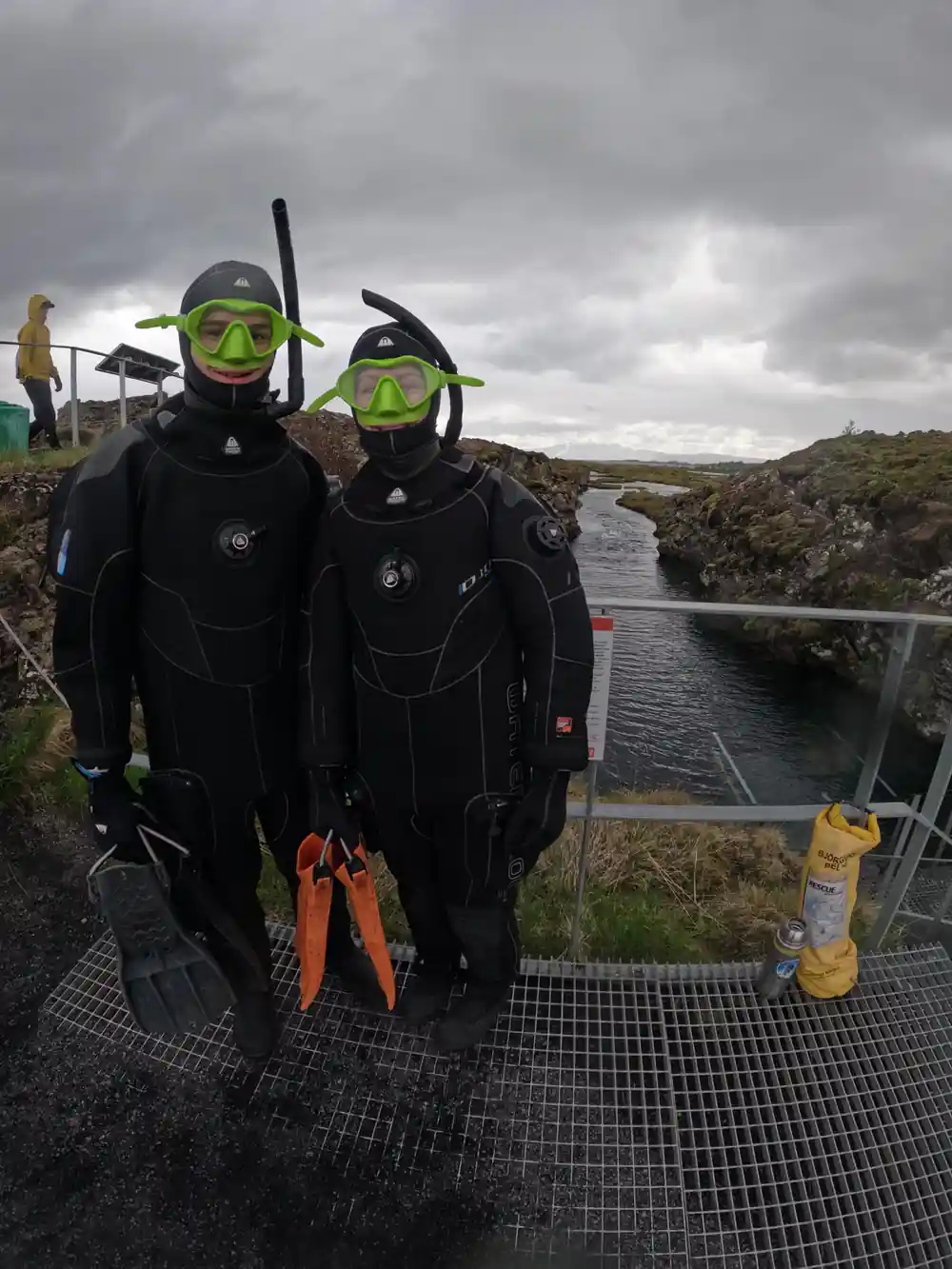
A dry suit stops at the neck, so the hood, gloves and boots are separate pieces of the same system. The hood goes on over the neck seal, tucking the rubber underneath. It covers your ears and forehead, which are usually the first places to ache. Pull it well down over your forehead before the mask goes on, and let the mask strap sit over the hood rather than under it. A hood that rides above the seal leaves a channel for water to run down your collar.
Gloves are the weak point for most people. Dry gloves attach to the wrist seal with a ring, keeping hands dry so a thin liner underneath is enough. Wet gloves let water in straight away and your fingers register it within minutes. Keep hands out of the water when you can, and let them hang relaxed rather than gripping the snorkel.
Boots and fins finish the set. You walk to the entry on rock and metal steps, then fin up just before you get in. Fit matters. Fins that are too tight restrict circulation in cold water, and fins that are too loose come off when you kick. Check straps while you are still standing on dry ground.
Getting sealed in: what to expect
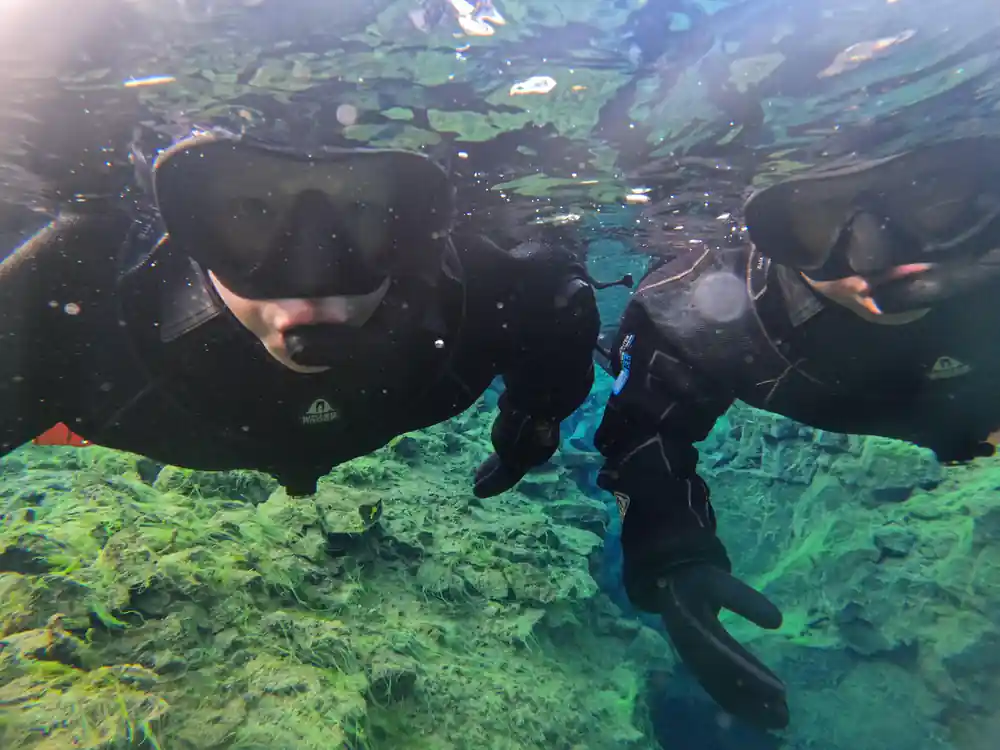
Suiting up takes longer than people expect, and most of it is checking. The guide walks you through the layers, the suit, the hood and the mask, then checks the neck, both wrists and the zip. This is the moment to speak up if something pinches or feels loose. Nobody minds repeating a check. If you have a camera, hand it over here; it is easier for the guide to hold while you work your arms into the suit.
The neck seal is the part that surprises people. It goes over your head, so there is a second or two of pressure across your face, then it settles against your throat. It should feel snug, like a firm hand resting there, not tight enough to restrict breathing. The wrist gaskets feel similar and are usually forgotten within a minute.
Then comes the air. The guide squeezes the suit at the neck to push the excess out, and the shell settles against your underlayer. You walk to the steps, sit, put your mask and snorkel in place and slide in. Cold hits your face and hands first. Your body stays dry inside the suit, which feels strange for a minute and then excellent.
Practical tips before you suit up
Read the rules before you book. To snorkel at Silfra you must be at least 12 years old and at least 150 cm tall, able to swim and comfortable in water. Life jackets and swimming aids are not permitted.[2] There is no flotation option in the water. Swimming confidence matters here.
Wear a warm base layer to the meeting point and bring spare socks. Tie long hair back; loose hair under a neck seal is uncomfortable and can break the seal you worked to get right. Contact lenses make the day simpler if you wear glasses. Rings and watches are best left behind, since jewellery snags on gaskets. A flask of something hot for afterwards is a small kindness you will appreciate.
Booking is simple. The tour booked from this site runs 3 - 5.5 hours depending on the starting time, keeps groups to 6 participants and starts from US$137, with free cancellation up to 24 hours in advance.[3] Pickup is available and you can reserve now and pay later.[3] Thingvellir National Park is 47 km northeast of Reykjavík on Route 36 and was added to UNESCO's World Heritage List in 2004.[8][9] The lake, Þingvallavatn, covers 84 square kilometres and reaches a greatest depth of 114 metres.[10]
Group size caps on Silfra snorkel and dive tours
Each value is the maximum group size stated on that listing.[3][4][11][12]
Silfra snorkel and dive from-prices
Amounts are US dollar from-prices per person on these GetYourGuide listings. None of them lists a separate child rate.[3][4][5][11]
When to book a dry suit snorkel
Getting sealed in
Check in and briefing
Meet the guide, go through the paperwork and hear the plan: where you enter the fissure, where you climb out and how the group moves.
Thermal layers first
Pull on the warm undersuit before the dry shell. Keep it smooth so nothing bunches under the gaskets at your neck and wrists.
Step into the shell
Feet first, then arms. The fabric does not stretch, so take your time getting your shoulders through and your hands out of the cuffs.
Seal neck and wrists
Gaskets sit against bare skin. A snug neck seal is normal; pinching, numbness or a tight throat is not. Ask the guide to check the fit.
Vent the air and test
Squeeze the extra air out at the neck, then squat, reach overhead and breathe through the snorkel to be sure everything holds.
Snorkel the fissure between two continents in a dry suit
from US$138Reserve now & pay later